In most companies, the hard part of innovation is not coming up with ideas. It is turning those ideas into something concrete early enough to know whether they are worth pursuing.
Typically, an idea goes through discussions, documents, and approvals before anything real exists. By the time a prototype is built, a lot of assumptions have already been locked in. If those assumptions are wrong, the cost of finding out is high. AI-led innovation labs are emerging as a way to change this sequence.
What an AI-Led Innovation Lab Really Is
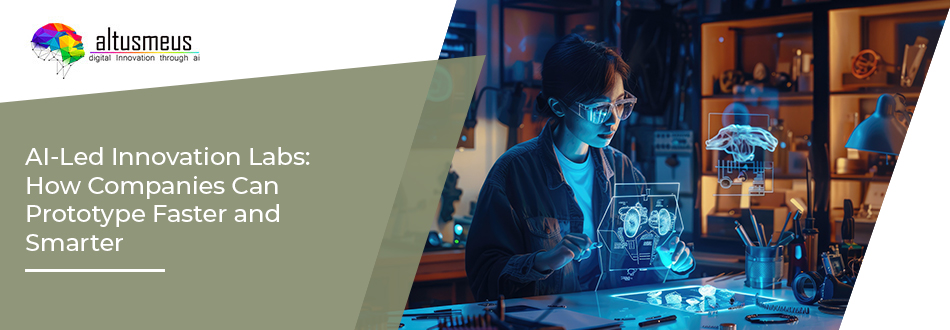
An AI-led innovation lab is not a physical lab or a showcase environment. It is a structured setup where teams use AI to shorten the gap between an idea and a working model.
The purpose is not to build production-ready systems on day one. The purpose is to test thinking.
Using generative AI, teams can quickly create early versions of products, workflows, or internal tools. These may be rough, but they are functional enough to answer basic questions:
- Does this solve the problem we think it does?
- Does this fit how users actually work?
- Are we missing something obvious?
Instead of debating these questions in theory, teams can see and interact with something real.
Why Prototyping Becomes Faster With AI
Traditionally, prototyping depends heavily on specialist skills. Engineers, designers, and data teams are often involved even for early experiments. Their time is limited, which naturally slows things down.
AI changes this dynamic. People who understand the business problem can now build early versions themselves, with AI handling much of the technical heavy lifting. This does not remove the need for experts later, but it allows early exploration to happen without waiting in line. As a result, more ideas can be tested, and they can be tested earlier.
Smarter Prototyping, Not Just Faster
Speed alone is not the point. The real benefit is that prototyping becomes more informative.
When teams can try multiple approaches quickly, they learn what works and what does not before making large commitments. Weak ideas fail early. Strong ideas improve through iteration.
This reduces the risk of investing heavily in the wrong direction. It also improves alignment, because teams are reacting to shared outputs instead of abstract descriptions.
How Altusmeus Supports AI-Led Innovation Labs
Altusmeus works with organizations that want to make experimentation a repeatable capability, not a one-off exercise.
The focus is on helping companies design AI-led innovation labs that fit their context. That includes selecting the right AI approaches, defining how teams should use them, and ensuring experiments are connected to real business goals.
Rather than treating AI as a standalone tool, Altusmeus helps integrate it into existing workflows so that teams can move from idea to prototype without unnecessary friction.
Moving From Prototype to Execution
One common failure in innovation efforts is that prototypes remain isolated experiments. AI-led innovation labs aim to avoid this by ensuring that what is learned early feeds into later stages.
Prototypes help teams clarify requirements, identify risks, and validate assumptions. When an idea moves forward, this early work reduces rework and speeds up execution.
In this way, prototyping becomes part of the delivery process, not a detour from it.
Conclusion
AI-led innovation labs address a practical problem: the high cost of testing ideas in large organizations.
By using AI to accelerate early exploration, companies can prototype faster and make smarter decisions about where to invest. The result is not just speed, but better judgment.
Organizations that adopt this approach are better equipped to adapt, because they learn earlier and commit later.